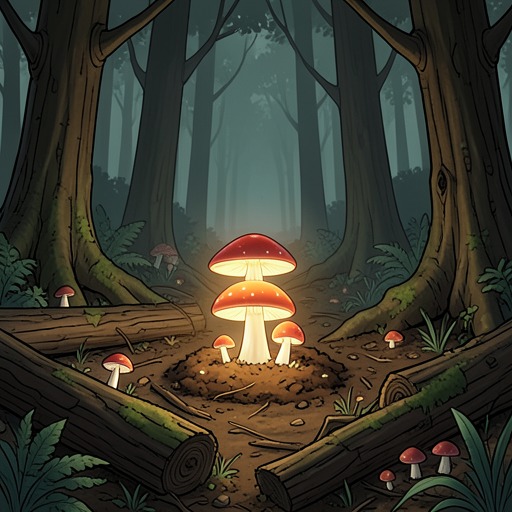
“Wood-wide web”
How to Change Your MindThe Wood-wide web is a term for the network linking trees in a forest, named by University of British Columbia scientists after tracking radioactive carbon as it moved from tree to tree. The phrase gives a memorable name to the study’s image of forest interconnection; the book notes that the paper’s wording was surely a tip of the hat to Paul Stamets.
The forest study and its findings
The researchers injected fir trees with radioactive carbon isotopes and followed the isotopes through the forest community using several sensing methods, including a Geiger counter. Within a few days, stores of radioactive carbon had been routed from tree to tree. The findings described exchange across a plot thirty meters square, where every tree was connected to the network.
The connections were not presented as evenly distributed. The oldest trees functioned as hubs, with some linked to as many as forty-seven others. When the scientists diagrammed the forest network, its shape resembled a map of the Internet. The term Wood-wide web brings together these concrete observations—movement between trees, central hubs, and a connected network—under a familiar technological metaphor.
A metaphor among other networks
The book also describes human networks that carry psychedelic research across places and institutions. In the late 1950s, Al Hubbard moved among research centers, sharing LSD and therapeutic knowledge with researchers including Humphry Osmond and Abram Hoffer in Weyburn, R. Gordon Wasson in Manhattan, and Betty Eisner, Sidney Cohen, and Oscar Janiger in Los Angeles. The account likens Hubbard to a psychedelic honeybee: a mobile intermediary linking otherwise distant centers. This is a social and professional network, not the forest system named by the Wood-wide web, but the comparison makes visible a recurring concern in the book: how something travels through connections rather than from a single center.
That pattern persisted in underground psychedelic practice. Guides interviewed by the author often traced their professional lineage to Timothy Leary, Stanislav Grof, Al Hubbard, or Leo Zeff. The book describes traffic between underground practitioners and university research, including the Hopkins team’s consultation with underground guides about music for guided psilocybin sessions. At a 2010 MAPS conference, James Fadiman called an early-morning meeting for guides and found a hundred people waiting. These examples show human knowledge moving through personal ties, training, and exchange, in a way that is suggestive of a network without being equivalent to the ecological finding.
What the name makes visible
The Internet comparison is grounded in the study’s diagram, but it also gives readers an accessible way to imagine connections that are not immediately visible at the level of a single tree. The oldest trees’ hub role and the rapid routing of carbon supply the term with specific structure and activity; it is not merely a decorative label for a forest.
Within the book’s wider account, the phrase resonates with its attention to distributed relationships: trees connected across a plot, researchers linked by travel and shared work, and therapeutic practices transmitted through lineages. The Wood-wide web names the ecological network itself. Its broader narrative significance lies in how sharply that name renders interdependence legible, while the human networks elsewhere in the book remain distinct histories with their own participants and routes.